





.png)




SJMC targets tumours with micrometre precision


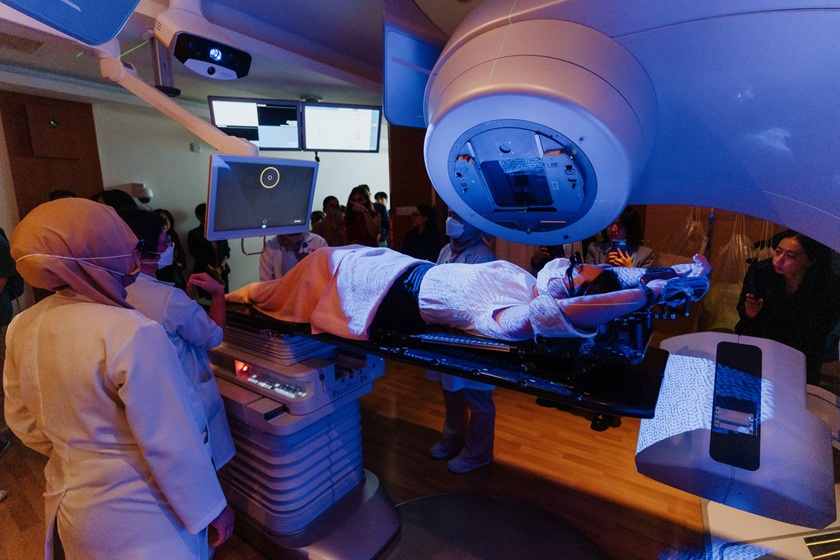
A model demonstrates how a patient could be positioned for the enhanced image-guidance system to work.
Patients who cannot undergo conventional surgery, particularly for advanced head and neck cancers, are usually recommended stereotactic radiosurgery.
This non-invasive technique works by focusing beams of high-dose radiation from different angles to a single point.
This combined dose is powerful enough to destroy the targeted abnormal cells while minimising damage to the surrounding healthy tissues.
There is no need for surgical cuts and the results achieved can be comparable to an operation.
With conventional radiotherapy, radiation is delivered at different times, at lower intensities, to larger areas, but with radiosurgery, it targets specific, often hard to reach, areas.
The intention is to cure the disease, control cancerous growth or relieve symptoms.
Recently, the ExacTrac Dynamic system – an enhanced image-guidance platform that brings sub-millimetre accuracy to radiosurgery – was introduced in Malaysia.
Spot the signs early
This comprehensive imaging system is integrated into a linear accelerator machine (Linac) – a device that is used in radiation therapy.
This new technology, which combines X-rays with 4D surface tracking and thermal imaging, allows clinicians to track and treat smaller tumours with greater accuracy, reduce exposure to surrounding organs and shorten the overall treatment process.
At the same time, it improves patient comfort as they wear an open mask (instead of the thermoplastic mask designed to cover the face) that allows them to breathe easier and maintain visibility during sessions.
“Different radiotherapy techniques are intended for different purposes.
“In cases where surgery is not possible, radiosurgery is the first line of treatment.
“In particular, with brain tumours, we have many surrounding organs at risk if a certain dose of radiation is exceeded and this is where the new system can help due to its sub-millimetre accuracy.
“For many, this means fewer treatment sessions, faster recovery, reduced hospital visits and less disruption to their daily lives,” says Dr Winnie Ng Nyek Ping, consultant clinical oncologist at Subang Jaya Medical Centre (SJMC).

Dr Winnie Ng
To give an analogy, she compares radiotherapy machines to cars.
She explains: “The system works like a GPS [global positioning system] in the car – the beam is focused on a particular site, which is hard to reach in conventional surgery.
“You programme it and it’ll guide you to the right place.
“If there is any small or minute movement, such as in the patient’s breathing (causing movement in the ribcage), the system will identify this and adjust the beam angle accordingly to allow the target to still get the optimal dose [i.e. GPS rerouted].
“If somehow, the patient’s breath goes beyond the normal range, the treatment will stop.”
The system is usually used for brain tumours, but it can also be used to treat areas in the lung, breast, prostate, spine, etc.
It is already being used in the United States and Europe, with studies reporting average errors below 0.1mm and 0.1 degrees for translational and rotational movements respectively.
However, the system cannot be used for the intestines or bowels as these organs tend to move around.
“They are not in a fixed position, so we cannot identify a particular spot to target, and we cannot radiate a big area or there will be major side effects such as nausea and vomiting,” says Dr Ng, who was speaking after the launch of the system at a private hospital here recently.
More important to note is that not every patient will benefit from this technology.
She says: “Patient suitability depends on the clinician’s decision, which is based on the tumour size and location, among other factors.
“For example, cancer patients with bone pain in the spine only need a fairly low dose of radiation, so they will not benefit from this new system – the existing methods will suffice.
“Like the GPS, you only need to use it for longer distances, but if the destination is nearby, you don’t need it.”
Cancer treatment is fairly standard worldwide and because of very stringent guidelines on what to do next, doctors cannot deviate much.
“Things are always evolving in oncology, and systems like ExacTrac Dynamic are reshaping how we manage complex cases,” she says.
Source: The Star